
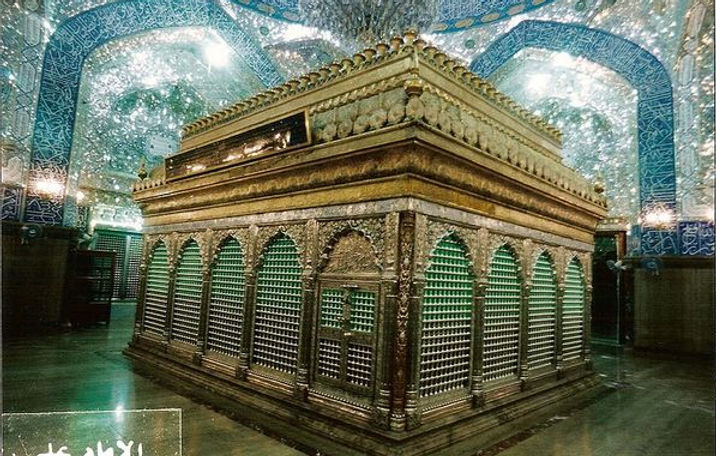
Imam al-Mashariq wal-Magharib

Hazrat Ali R.A.

The Imam from the East to the West

The Noble Character and Life of Hazrat Ali R.A.

Born within the sacred sanctuary of the Kaaba, Hazrat Ali ibn Abi Talib (R.A.) was the beloved cousin and son-in-law of Prophet Muhammad (PBUH). Revered as the “Lion of God,” his life remains a profound testament to unparalleled courage, spiritual depth, and a sea of knowledge and wisdom. As the fourth Caliph of Islam, his timeless wisdom continues to illuminate the path for seekers of truth and righteousness in the modern world.

The Holy Prophet (PBUH) famously declared, I am the city of knowledge, and Ali is its gate, signifying his extraordinary intellect and nobility. His counsel was so highly valued that even the preceding Caliphs frequently sought his guidance on the most complex matters of state and faith. He served with distinction as the fourth Caliph, upholding the principles of equity and meritocracy.

Beyond his temporal leadership, the Prophet (PBUH) affirmed the spiritual sovereignty of Hazrat Ali (R.A.) at Ghadir Khumm, stating: Whomsoever I am the Master (Maula) of, Ali is also his Master. He further emphasised this unique bond by noting that Ali is the protector (Wali) of every believer after me, establishing a legacy of spiritual guardianship.

A carved stone archway at sunset opening onto green hills and fields

Hazrat Ali (R.A.) holds the honour of being the first youth to embrace Islam, accepting the message with unwavering conviction. As a chosen recipient of the profound inner knowledge (Ma'rifa) directly from the Prophet (PBUH), he remains a foundational pillar for those journeying toward divine proximity and spiritual excellence.

He was also renowned for his immense piety and steadfastness. Hazrat Umar (R.A.), the second Caliph, famously observed, No one excelled Ali in prayer. A poignant account relates how an arrow once pierced his leg; so profound was his devotion that it was removed while he was in deep prayer, and he remained entirely undisturbed by the sensation.

Hazrat Ali’s bravery on the battlefield was legendary. In the Battle of Badr, in the famous three duels, he defeated his opponent Al-Walid in a decisive duel and assisted Hazrat Ubaydah ibn al-Harith (R.A.) in securing victory against his opponent. When the main battle began at Badr, observers witnessed Hazrat Ali (R.A.) defeating opponents in great numbers. At the Battle of Khaybar, after several others had failed, the Holy Prophet (PBUH) entrusted the banner to Hazrat Ali, who conquered the fortress and famously uprooted its heavy gate with a single hand. He is eternally honoured as “Haider-e-Karrar” — the Valiant Lion who never retreats.

Honorifics

Sacred Titles and Eternal Guidance

  • Imam al-Mashariq wal-Magharib

    • Wali-e-Kullu Mu'mineen
    • Maula-e-Kainaat

    Established through the historic declaration at Ghadir Khumm, these sacred honorifics confirm his supreme spiritual authority. ‘Imam al-Mashariq wal-Magharib’ designates him as the Spiritual Leader of the East to the West; ‘Wali-e-Kullu Mu'mineen’ as the Guardian of all believers; and ‘Maula-e-Kainaat’ as the Master (Maula) of the Universe, second only to the Holy Prophet Muhammad (S.A.W.).

    All these signify the inheritance of the spiritual leadership which is often referred to as Imamat or Wilayat. This must not be confused with Khilafat, or political leadership, which the Holy Prophet Muhammad left the Muslims to decide, choosing their ruler by their own choice.

  • Abu Turab

    The title ‘Abu Turab,’ or ‘Father of Dust,’ refers to his conquest of his body (self). This shows his profound humility and absolute mastery over the self. It symbolises a life where worldly desires were transcended, anchoring his immense spiritual presence in total modesty and devotion.

  • Haider-e-Karrar & Asadullahil Ghalib

    These titles celebrate the legendary bravery of Hazrat Ali (R.A.). ‘Haider-e-Karrar’ signifies the Valiant Lion who never retreats, while ‘Asadullahil Ghalib’ honours him as the Victorious Lion of God, representing his bravery and courage.

  • Karramallāhu Wajhahūl-Karīm

    This blessed title is uniquely associated with Ali ibn Abi Talib (R.A.) because he accepted Islam at a young age under the influence of the Holy Prophet Muhammad (S.A.W.) and is reported never to have prostrated before idols. Scholars say his face was honoured by Allah as it bowed only in worship to Him. The phrase expresses deep love, reverence, and recognition of his spiritual nobility and closeness to Muhammad.

Imamat & Wilayat

The Legacy of Spiritual Sovereignty

The profound influence of Hazrat Ali (R.A.) transcends the boundaries of time. Just as the legacy of the political governance of the Holy Prophet Muhammad continued through Hazrat Abu Bakr Siddiq (R.A.) and the other Caliphs, so the legacy of the spiritual leadership of the Holy Prophet continues through Hazrat Ali (R.A.).

He was entrusted with the mantle of spiritual sovereignty. This sacred authority, known as the Imamat, flourished through the noble progeny of the Prophet — the descendants of Hazrat Fatima (R.A.) and Hazrat Ali (R.A.). These revered guides are honoured as the Twelve Imams, with Imam Mahdi (A.S.) as the final beacon in this divine lineage.

While the specific belief in the Twelve Imams is considered optional within Sunni tradition, the recognition of the spiritual sovereignty of Hazrat Ali (R.A.) and Imam Mahdi (A.S.) is regarded as a fundamental tenet of faith in Sunni belief. The Twelve Imams are mentioned in the Qadiriya and Chishtiya silsilas, as well as in many other paths of Tariqat. It is a misconception that reverence for the Twelve Imams is exclusive to Shia Muslims.

Here is a reference from the prominent Sunni scholar Shaykh Ahmad Sirhindī:

And when his (Hazrat Ali R.A.) period ended, the grand office passed on to Hasan and Husayn and then on to each one of the twelve Imāms, individually and elaborately. And whosoever received guidance in their life and after their death, received it through these saints (Imams). And the refuge and place of shelter of the saints (Awliya), even those of high ranks, are these saints (Imams), because they are the centre of all spiritual activity, and the sides tend to converge on the centre.

— Shaykh Ahmad Sirhindī, Maktūbāt (9:173 #123)